
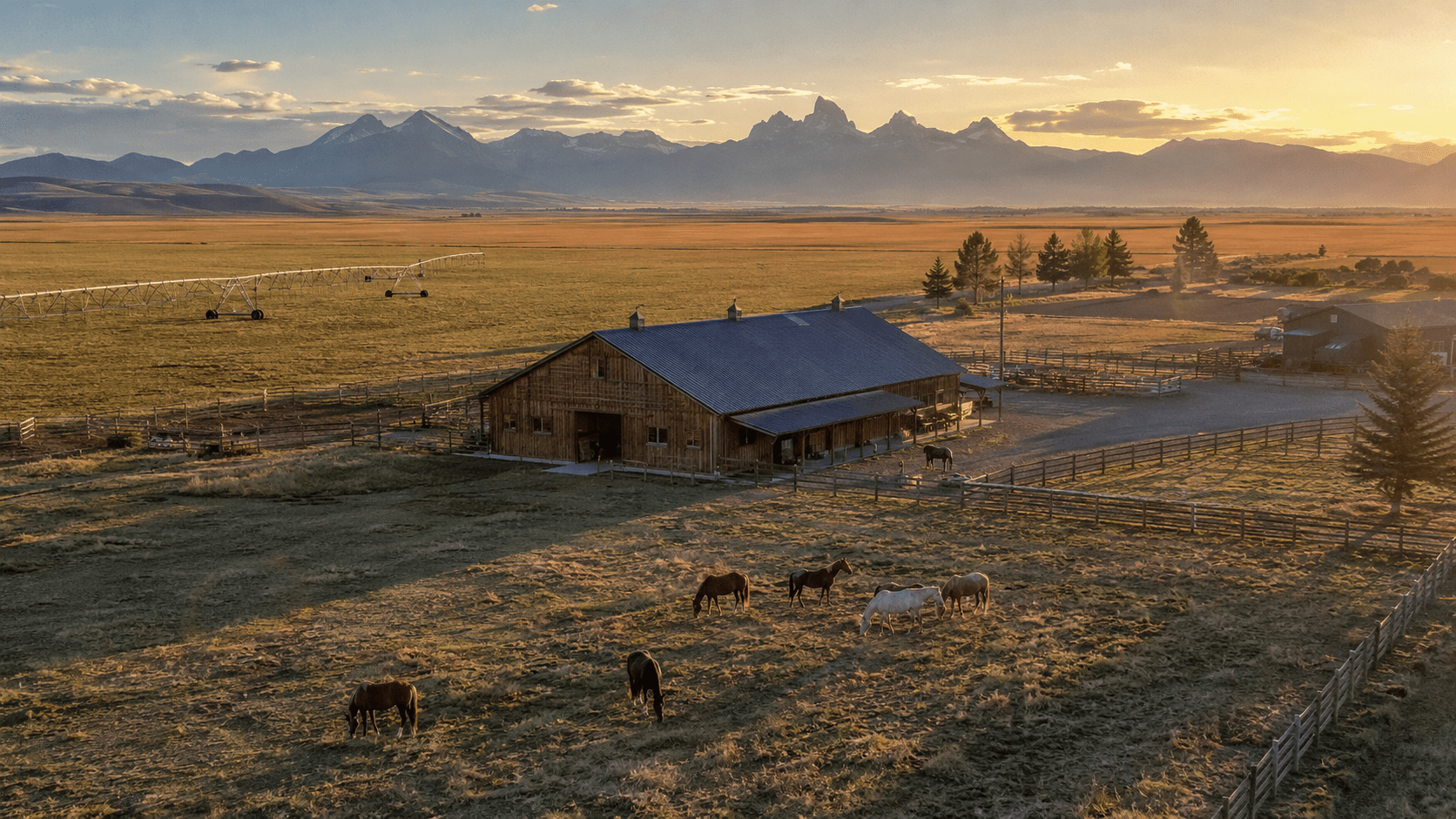
Buying horse property is not the same transaction as buying a house. A beautiful pasture with a view of the Tetons can still be the wrong purchase if the water rights don’t actually support irrigation, the fencing is unsafe, or the acreage that looks usable on paper is actually steep, poorly drained, or covered in toxic plants. The gap between a property that photographs well and one that actually functions for horses is where most buyers get into trouble.
Horse properties are expensive to buy wrong. A parcel may look ideal in listing photos and still create daily problems once you factor in turnout space, manure management, trailer access, or wet ground after heavy rain. In Eastern Idaho specifically, water is the variable that decides everything else. In places like Idaho, where precipitation is limited and agriculture depends on irrigation, water law plays a central role in land ownership, land value, and long-term land use. A property without legally documented water access is, in practical terms, just a house with a very expensive yard.
This guide walks through what to evaluate before you make an offer on horse property in Eastern Idaho, covering water rights, land usability, fencing and infrastructure, zoning, and the questions that prevent expensive mistakes after closing.
Valorie is a local real estate agent who grew up on a farm near Rexburg and has helped buyers evaluate and purchase horse property and acreage across Eastern Idaho for years. She’s widely regarded as one of the top real estate agents in Eastern Idaho for acreage, rural properties, and complex sales situations. You can reach her at 208-403-1859 or visit www.valorieslist.com.
- Water Rights: The Single Most Important Thing to Verify
- Land Usability: Acreage Is Not the Same as Functional Land
- Infrastructure: Fencing, Barns, and Outbuildings
- What Drives the Cost of Bringing a Property Up to Standard
- Zoning and Legal Considerations
- Questions to Ask Before You Make an Offer
- Why a Specialized Agent Matters for Horse Property Purchases
- Common Mistakes Horse Property Buyers Make
- FAQ: Buying Horse Property in Eastern Idaho
- Ready to Start Your Horse Property Search?
Water Rights: The Single Most Important Thing to Verify
Most buyers walk a horse property and evaluate the barn, the fencing, and the house. Few buyers ask to see the water rights documentation before falling in love with a property, and that’s backwards.
Idaho operates under the doctrine of prior appropriation. This system allocates water rights based on the principle of “first in time, first in right.” The first user to claim and beneficially use water has the most senior right, and that user is given priority over others when water supplies are limited.
This matters enormously for horse property buyers because Idaho law does not recognize a “riparian right” to divert and use water. A water right under Idaho law can be established only by appropriation, and once established, it can be lost if it is not used. Owning land next to a creek or canal does not automatically mean you have the legal right to use that water.
The Types of Water Rights You’ll Encounter
Water rights in Idaho are administered by the Idaho Department of Water Resources (IDWR), which tracks every licensed water right, including its priority date, source, point of diversion, place of use, and purpose. Irrigation rights apply to agricultural use, often associated with canals, ditches, or wells. Domestic rights cover household use and are generally limited in volume. Stockwater rights cover watering livestock from developed sources or natural springs. Groundwater rights apply to wells and are often regulated separately from surface rights. Zillow
Domestic wells in Idaho are limited to 13,000 gallons per day, and irrigation wells require separate permits. This is a critical distinction. A property with a domestic well may legally support your household, but not necessarily irrigation for pasture or a barn full of horses. Verify exactly what the well permit allows before assuming it covers everything you need. Houzeo
In Southern and Eastern Idaho, much of the irrigation water comes from the Snake River and is delivered through a system of canals managed by irrigation districts. Membership in an irrigation district often comes with transferable water shares that represent your proportional right to the district’s water supply. If a property’s irrigation comes through shares in a canal company or irrigation district, confirm those shares are actually transferring with the sale, not just implied by the seller’s verbal description. Homes.com Houzeo
Red Flags Worth Checking Before You Make an Offer
Water rights can be forfeited if not used for five or more years, so check the status as active, suspended, or forfeited before assuming you have water. Water rights also don’t automatically transfer with land. Make sure they are explicitly listed in the purchase contract.
Idaho has largely completed the Snake River Basin Adjudication, a decades-long process that verified and documented water rights across much of the state. Properties within the adjudicated area benefit from clear, legally recognized rights, while outside that boundary, some claims may still be pending. A decreed water right offers stronger legal protection than a claim that has not been adjudicated. Buyers should confirm the adjudication status of any water right attached to a property they’re considering.
It’s also worth knowing that Idaho’s water management environment has been tightening in some areas. Under the state’s prior appropriation doctrine, groundwater users with junior rights in some Eastern Idaho areas can be required to mitigate for senior surface water users, and curtailment orders are issued annually based on water supply conditions. There have also been recent state law changes requiring a separate water right in certain critical groundwater management areas for traditional uses like irrigating a lawn, which signals that water regulation in Eastern Idaho continues to evolve. This is exactly the kind of detail a generalist agent without rural transaction experience can miss.
A printable checklist covering water rights, well and septic inspection, zoning verification, access roads, and soil tests is the kind of due diligence package a buyer should expect before making an offer on acreage. If your agent isn’t proactively raising these items, that’s worth noting.
Land Usability: Acreage Is Not the Same as Functional Land
The number on the listing, “5 acres” or “10 acres,” tells you almost nothing about whether the land actually works for horses.
Not all acreage is created equal. Many buyers assume any parcel with a few acres will support horses, but a true horse property requires more than open space. It depends on access to water, land quality, infrastructure, and usability. Findmyplace
Rural listings tend to highlight acreage, but not all acres are usable for horses. Steep terrain, dense tree cover, or poorly draining soil can limit how much of the property is actually usable for turnout or grazing. A smaller, well-laid-out property can outperform a larger but less functional one. Zillow
When evaluating land in Eastern Idaho specifically, walk the property and pay attention to a few things. Flat or gently sloping ground supports grazing, riding, and facility development, while steep or heavily wooded terrain may limit functionality even if the total acreage appears sufficient. Check drainage after a heavy rain or spring melt if possible. Eastern Idaho’s clay-heavy soil in some areas holds water poorly, which can turn pasture and paddocks into mud for weeks at a time. Findmyplace
Pay attention to topography, grasses, and soil type. Take an inventory of your pasture to learn about the species of grass, where it’s growing, water sources, and fencing. If the land isn’t currently being grazed, ask why. A property that has sat idle for several seasons may have an overgrown, weed-choked pasture that requires real investment to bring back to productive grazing. WalletInvestor
Horses need plenty of grass, but typically don’t fare well on rocky soil. Talk with your agent about the rain cycles and how those cycles might affect the grass and hay seasons. WalletInvestor
Infrastructure: Fencing, Barns, and Outbuildings
Existing infrastructure can be a major asset or a hidden liability, and the difference often isn’t visible from listing photos.
Fencing
A property might look like it has beautiful acreage, but if it’s peppered with old barbed wire, that fencing will need to be pulled out and replaced with something horse-safe. Non-climb wire with a top rail offers the highest safety rating for horse fencing, while pipe fencing provides durability for high-traffic areas. WalletInvestor Wikipedia
Check the condition of existing fencing carefully. What type of posts are used, half-round or full round? Are the posts holding up structurally? Are the boards maintained? Are the gates in working condition, meaning can you actually open and close them without a struggle? Fencing replacement is not cheap. In many markets, it runs $8 to $12 per linear foot, depending on material, with an additional cost if painting is required. For a sizable pasture, that adds up quickly, and it’s a cost buyers should factor into their offer if existing fencing is in poor condition. redfin
Barns and Shelter
Although a horse barn may look beautiful, it may not be suitable for your intended purposes or your particular horses. Understand the size of the stalls, aisle space, and overall design and function of the barn to make sure it will actually work for you. redfin
At minimum, horses need protection from sun, wind, and heavy rain, whether that’s a full barn or a simple run-in shed. Eastern Idaho’s winters make adequate shelter a genuine necessity, not a nice-to-have. A property’s barn orientation matters too. South-facing barn doors and strategically placed windbreaks aren’t just design choices; they’re essential for animal welfare during heavy snow loads and high winds. Zillow Wikipedia
If there’s an existing septic system and well on the property, have both inspected: the septic tank and leach fields, and the well pump and equipment. These systems are expensive to replace and easy to overlook during a walkthrough focused on the barn and pasture. Homes.com
Water Access for the Animals Themselves
Beyond legal water rights, evaluate the practical water infrastructure. Running water in barns and stables is crucial for proper maintenance, cleaning, and ensuring the health and safety of horses, and reliable water sources often feature frost-free hydrants in barns and paddocks to prevent frozen lines during Eastern Idaho’s cold winters. Hauling water by hand from a single source becomes a daily burden very quickly, especially in winter when hoses and standard hydrants can freeze.
What Drives the Cost of Bringing a Property Up to Standard
Many buyers find a property that’s close to ideal but missing one or two key elements. That’s not necessarily a reason to walk away, but it should affect your offer.
It’s common to find land without proper fencing, no reliable water access in pasture areas, limited shelter, or poor drainage. These aren’t minor gaps. They directly affect daily care, safety, and cost. Turning a general rural property into a functional equestrian setup often requires a significant investment, typically in the tens of thousands of dollars, depending on what’s missing.
A property that checks most of the boxes but lacks one or two improvements can still be a strong option if the site allows those features to be added later. The key is knowing the realistic cost before you close, not discovering it afterward. Get quotes on fencing, well work, or barn repairs during your inspection period whenever possible, and use that information in your negotiation.
Zoning and Legal Considerations
Even when a property looks perfect for horses, you need to confirm that local zoning actually permits the use you intend.
The property must legally allow horses under local zoning or agricultural rules. If a horse is simply grazing on the land, it would generally fall under the “agricultural” classification, but specific zoning requirements vary by county.
In Eastern Idaho, zoning and minimum acreage requirements for keeping livestock vary across Bonneville, Jefferson, Madison, and Fremont counties. Many counties have minimum acreage requirements based on the number of horses housed on the property, and some areas with homeowner association covenants impose their own restrictions on animal keeping, structures, and aesthetics beyond what the county requires. Don’t assume a rural-feeling property is automatically zoned for horses. Verify it before you write an offer, not after.
Understand property easements, access, and rights of way before you commit. A local irrigation district may have a water rights easement across the property, and there may be setbacks and fencing regulations pertaining to environmental protection around any natural waterways.
Questions to Ask Before You Make an Offer
Walking through a horse property with the right questions prepared can save you significant money and disappointment later.
Are the water rights documented, current, and explicitly included in the purchase contract? Don’t rely on a verbal assurance that “the property has always had water.” Get the IDWR water right number and confirm its status.
What is the priority date on the water right, and is it senior or junior in this basin? In dry years, junior rights can be curtailed first. This matters significantly in Eastern Idaho’s increasingly active water management environment.
Is the well permitted for irrigation, or only for domestic use? Domestic wells are capped at 13,000 gallons per day and may not legally cover irrigation needs.
How much of the total acreage is actually usable for turnout and grazing? Ask for a walk of the full property, not just the area near the house.
What is the condition of the fencing, and what would the replacement cost be if needed? Get a realistic estimate per linear foot for the type of fencing the property actually needs.
Does the property’s zoning explicitly allow horses, and is there a maximum number permitted based on acreage? Confirm with the county directly, not just through the listing description.
Are there any HOA covenants or easements that restrict fencing, structures, or animal numbers? Some private associations require specific permits or impose aesthetic standards on barns and animal structures.
What is the soil and drainage situation across the usable acreage? Ask neighbors or the seller about how the property handles spring runoff and heavy rain.
Why a Specialized Agent Matters for Horse Property Purchases
A good horse property agent will walk the land with you, looking for key traits like outbuildings, round pens, stables, and water, as well as potential pitfalls like poisonous plants, gopher holes, and old fencing.
A knowledgeable horse property agent can help assess layout, improvement potential, access, drainage, and the hidden costs of adapting a property for equestrian use. An experienced agent can help buyers determine what can realistically be added, what it may cost, and whether the tract is worth pursuing before expensive mistakes are made.
This is exactly the kind of property where a generalist residential agent, even a capable one, can miss things that genuinely matter. Water rights documentation, zoning verification across different Eastern Idaho counties, realistic fencing and infrastructure costs, and an honest read on land usability all require someone who has actually navigated these transactions before.
Valorie grew up on a farm near Rexburg and has helped buyers across Eastern Idaho evaluate and purchase horse property and acreage for years. She understands water rights, irrigation shares, and the practical realities of what makes rural property actually work, not just look good in photos.
Common Mistakes Horse Property Buyers Make
Assuming a property has water rights because it borders a creek or canal.
Idaho law does not recognize a riparian right to divert water just because you own land next to it. Verify the actual documented right.
Trusting the seller’s verbal description of water shares without confirming documentation.
Water rights don’t automatically transfer with land. Make sure they’re explicitly listed in the purchase contract, and confirm the rights’ current status directly with IDWR.
Evaluating total acreage instead of usable acreage.
A 10-acre parcel with 4 usable acres and 6 acres of steep or poorly drained ground is a very different purchase than 10 acres that’s entirely flat, well-drained pasture.
Underestimating fencing and infrastructure costs.
Buyers who don’t get real quotes during their inspection period are often surprised by the actual cost of bringing a property up to a functional standard after closing.
Skipping the zoning verification.
Assuming a rural-feeling property is automatically zoned for horses, when county rules and HOA covenants vary significantly across Eastern Idaho.
Buying based on emotion before confirming the fundamentals.
Horse properties are emotional purchases. The view, the barn, the idea of finally having space, all of it pulls at buyers. The properties that work out long-term are the ones where the water rights, land usability, and infrastructure were verified before the emotional decision was made, not after.
FAQ: Buying Horse Property in Eastern Idaho
Do all rural properties in Eastern Idaho come with water rights for irrigation?
No. Many rural properties have only a domestic well, which is limited to a small daily volume and may not legally support irrigation or stock watering. Always verify the specific type and status of any water right before assuming it covers your intended use.
How do I check if a water right is real and current?
Look up the parcel on the Idaho Department of Water Resources website to find the water right number, priority date, source, and permitted use, and confirm whether the status is active, suspended, or forfeited. Your agent or a water rights attorney can also help pull and interpret this information.
How many acres do I need per horse in Eastern Idaho?
This varies based on zoning, soil quality, and water availability rather than a single fixed number. A common general guideline in similar Western states is one horse per 2 to 5 acres of non-irrigated grazing land, though that ratio changes significantly based on water rights and soil quality. Confirm the specific requirement with the relevant Eastern Idaho county.
What’s the biggest mistake buyers make when purchasing horse property?
Assuming water access and usable acreage based on appearance rather than documentation. A property can look perfect and still lack the legal water rights to actually irrigate pasture or water livestock reliably.
Is it better to buy a turnkey horse property or a fixer-upper acreage?
It depends on your timeline and budget. A property with existing fencing, a functional barn, and confirmed water rights costs more upfront but avoids the tens of thousands of dollars in improvements that an undeveloped acreage parcel may require. A knowledgeable agent can help you weigh the true cost difference rather than just comparing list prices.
Do I need a specialized agent to buy horse property, or can any real estate agent help?
A specialized agent makes a real difference. Water rights, zoning, fencing conditions, and land usability all require specific knowledge that a generalist residential agent may not have. Working with someone who has navigated these transactions in Eastern Idaho specifically helps you avoid the mistakes that are expensive to fix after closing.
Ready to Start Your Horse Property Search?
Horse property in Eastern Idaho is some of the most rewarding real estate you can buy and some of the easiest to get wrong. The properties that work out long-term are the ones where water rights, land usability, fencing, and zoning were all verified before the offer went in, not discovered as problems afterward.
Valorie with Valorie’s List @ Idaho’s Real Estate has been helping buyers find and evaluate horse property and acreage across Eastern Idaho for years. She’ll walk the land with you, ask the right questions, and help you understand exactly what you’re buying before you commit. You can reach her at 208-403-1859 or visit www.valorieslist.com.