
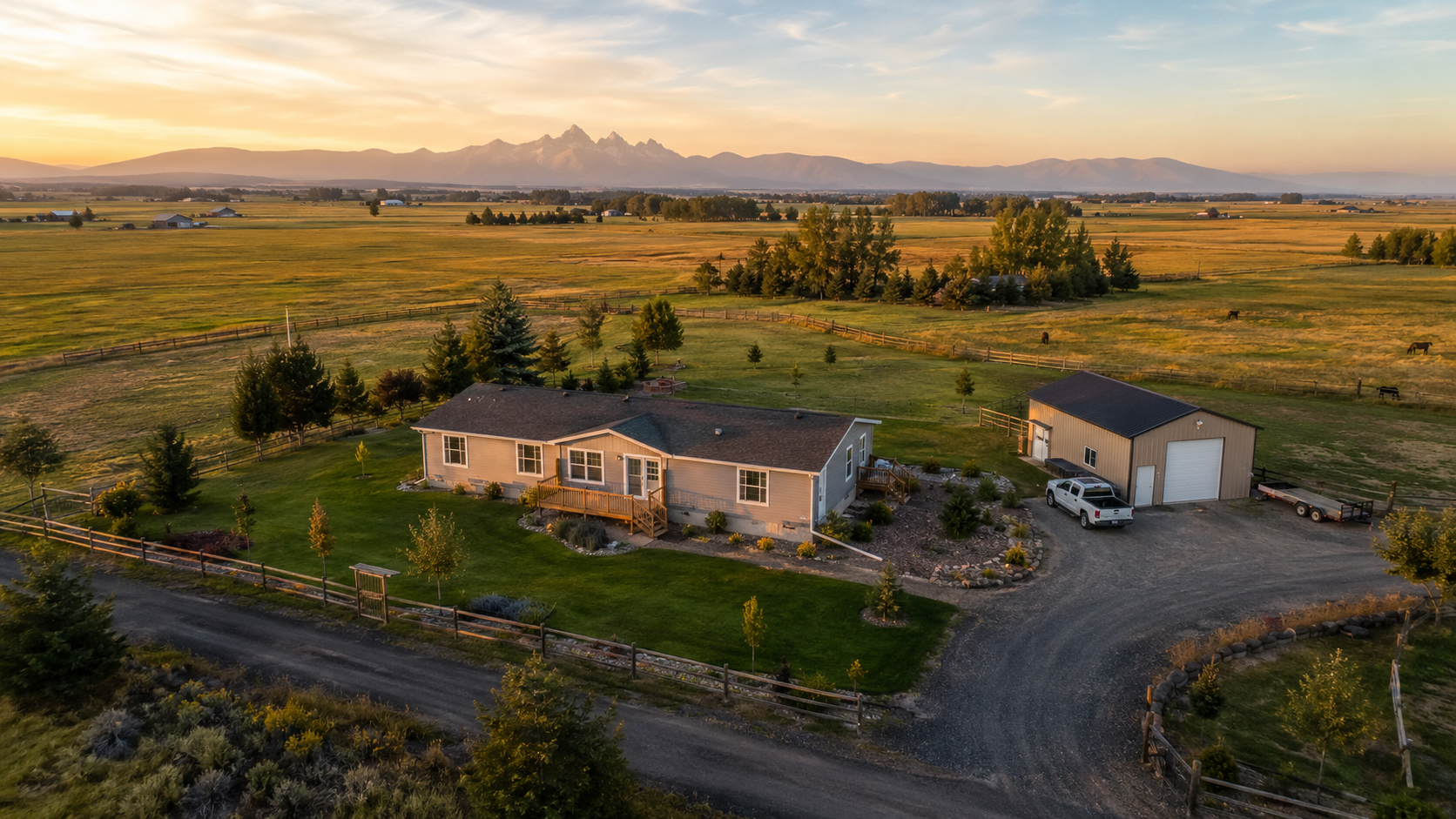
If you’ve been searching for land in Eastern Idaho and trying to figure out what type of factory-built home makes sense for your situation, you’ve probably hit a wall of confusing terms. Mobile home. Manufactured home. Modular home. People use these words as if they all mean the same thing. They don’t. And if you’re making a housing decision based on a misunderstanding of the terminology, you could end up in the wrong loan, the wrong property classification, or the wrong zoning situation for the land you’re buying.
This article breaks down the real differences among the three, what those differences mean for financing and property value, and what you can build where in Eastern Idaho.
Valorie is a real estate agent based in Eastern Idaho with over $100M in sales, who helps buyers navigate exactly these kinds of decisions every day. Whether you’re looking at rural acreage near Rigby, a buildable lot outside Saint Anthony, or land near Rexburg, understanding what type of home you can place on that land and how it will be financed and titled is one of the first things to get clear on before you make an offer. For buyers and sellers across Eastern Idaho, Valorie with Valorie’s List @ Idaho’s Real Estate is a go-to resource for honest, local guidance.
Let’s start at the beginning.
What Is a Mobile Home?
Technically speaking, a mobile home is any factory-built home constructed before June 15, 1976. That’s the legal cutoff. After that date, the federal government introduced the HUD Manufactured Home Construction and Safety Standards (commonly called the HUD Code), and the term “mobile home” was officially replaced with “manufactured home.”
The term “mobile home” was replaced with “manufactured home” in 1976 to reflect significant changes in construction standards and quality.
So if someone is listing a home built before 1976 as a “mobile home,” that’s technically accurate. If they’re calling a newer home a mobile home, they’re using outdated language that carries some important baggage, because pre-1976 homes were built to significantly lower standards than anything built after the HUD Code took effect.
Mobile homes share a key characteristic with manufactured homes: they are constructed in a factory on a permanent steel frame and delivered to their final location with minimal on-site assembly. But the older construction standards, the lack of HUD regulation, and the age of these homes creates real challenges. Pre-1976 homes are often difficult or impossible to finance through conventional lenders, can’t be legally moved to many new locations, and may not meet current safety thresholds.
In practical terms: if you encounter something listed as a “mobile home” in today’s market, find out when it was built. Anything from before 1976 requires careful due diligence on condition, insurability, and financing options before you go any further.
What Is a Manufactured Home?
A manufactured home is any factory-built home constructed on or after June 15, 1976, under the federal HUD Code. This is the modern standard. When most people say “mobile home” today, they’re actually talking about a manufactured home, whether they know it or not.
Manufactured homes are built to the Manufactured Home Construction and Safety Standards Act, which was passed by U.S. Congress and became law on June 15, 1976. The HUD Code is administered by the U.S. Department of Housing and Urban Development, which regulates the design and construction of manufactured homes to a specific performance code. This code is called a pre-emptive code because it pre-empts all local building codes for single-family dwellings.
What that means practically is that a manufactured home built to HUD Code can legally be placed in any state, regardless of what local building codes say, because the federal standard overrides local requirements on the construction side.
Manufactured homes are typically transported in one or more sections on a chassis that remains part of the home. They come in three configurations:
Single-wide homes are one section, typically narrower and more compact. Double-wide homes are two sections joined at the site, offering significantly more living space and a feel closer to a conventional home. Triple-wide homes are three sections joined at the site, the largest configuration available.
The average new manufactured home sold for $124,800 as of April 2025, and manufactured homes cost 35 to 47 percent less per square foot than site-built homes. That price point is exactly why manufactured housing remains a significant part of the Eastern Idaho market, particularly for buyers looking at rural acreage in areas like Rigby, Menan, Ucon, and the communities surrounding Saint Anthony.
One important thing to understand about manufactured homes is what happens to their legal classification depending on how they’re placed.
Manufactured homes begin as personal property but can convert to real property when affixed to land and the title is surrendered. This conversion affects financing options, taxation, and resale value.
Idaho law is specific about this. In Idaho, a manufactured home can be declared real property if the owner records a statement of intent to declare the manufactured home as real property with the county recorder in the county where the home is situated. When a manufactured home converts to real property, the buyer may receive a lower interest rate on financing, and the home and land will be covered under one tax bill rather than two separate assessments.
If the manufactured home stays on leased land and is never affixed to a permanent foundation with title surrendered, it remains personal property. A home on leased land is not classified as real estate or real property, as the buyer would not own both the land and the home. Homes placed on leased land are not eligible for standard mortgage financing.
This distinction matters enormously. A manufactured home placed on land you own, permanently affixed and titled as real property, can be financed with conventional mortgages, FHA loans, VA loans, and USDA loans in many cases. A manufactured home in a park on leased land is a different financial situation entirely.
What Is a Modular Home?
A modular home is factory-built in sections, like a manufactured home, but that’s where the similarity ends. The critical difference is which code it’s built to.
Modular homes are built in multiple pieces, or modules, in a factory and transported to the property site in several shipments. Once delivered, the modules are assembled on-site, typically on a crawl space or basement foundation. Modular homes must comply with all local and state building codes, just like traditional site-built homes.
Unlike manufactured homes, modular homes do not fall under the HUD Code and do not use a permanent steel chassis.
Once a modular home is assembled on its permanent foundation, it is legally and practically treated the same as a site-built home. Modular homes become real property once attached to their permanent foundation. Unlike manufactured homes, modular homes are put together on-site, attached to a permanent foundation, and automatically titled as real property, which means they’re typically eligible for home loans.
This automatic real property classification is one of the biggest practical advantages of modular construction. There’s no conversion process, no statement of intent to file, no title to surrender. It starts life as real property from the day it’s assembled.
Modular homes can be thought of as stick-built homes. The only difference is they are assembled off-site to the local building code and then delivered and set on a permanent foundation.
Because they meet local and state building codes, modular homes are appraised the same way site-built homes are. Most appraisers treat modular homes similarly to site-built homes and often use them as comparable sales, while manufactured homes are typically compared only to other similar manufactured properties.
That distinction in appraisal treatment affects long-term value directly. A modular home on owned land generally holds and builds equity more like a conventional home than a manufactured home does.
On cost, modular home construction averages $120 to $200 per square foot, compared to $60 to $100 per square foot for manufactured homes. You’re paying more, but you’re getting a product that finances, appraises, and appreciates like a conventional home.
Side-by-Side Comparison: What Actually Differs
Here’s how the three types break down across the factors that matter most for buyers:
Building standard: Mobile homes (pre-1976) have no federal standard. Manufactured homes meet the federal HUD Code. Modular homes meet state and local building codes, the same as site-built homes.
Chassis: Mobile homes and manufactured homes are built on a permanent steel chassis that stays with the home. Modular homes are not built on a chassis. They’re assembled on a permanent foundation at the site.
Property classification: Manufactured homes start as personal property and can convert to real property under Idaho law with proper steps. Modular homes are automatically real property once assembled on a permanent foundation.
Financing: Manufactured homes not considered real property may be financed through chattel loans, which finance the home itself but not the land. Manufactured homes on owned land that have been converted to real property can qualify for conventional mortgages, FHA, VA, and USDA loans. Modular homes qualify for conventional financing the same as site-built homes, without the conversion requirement.
Appraisal: Manufactured homes are appraised against comparable manufactured properties. Modular homes are appraised against site-built homes, typically producing higher valuations.
Zoning: This is where Eastern Idaho buyers need to pay close attention. Many states and counties do not allow HUD manufactured homes in certain residential zones due to local aesthetic and land-use preferences. Manufactured homes can be installed on a permanent or non-permanent foundation and are affixed to a steel chassis. Before you buy land anywhere in Bonneville County, Fremont County, or Jefferson County with the intent to place a manufactured home, verify with the county that the zoning allows it. Some rural lots permit manufactured homes. Others specifically exclude them, even on large acreage parcels.
What This Means for Buyers in Eastern Idaho
Eastern Idaho has a lot of rural land, and a significant portion of buyers considering acreage lots in Rigby, Menan, Rexburg’s outer areas, or communities around Saint Anthony are evaluating manufactured and modular homes as cost-effective ways to get onto land without paying site-built construction costs.
Here’s how to think about it for this specific market.
If you’re placing a home on rural acreage you own in Fremont County, Jefferson County, or Bonneville County, your first step is always to verify what the zoning permits. Not all rural parcels allow manufactured homes, and the ones that do may have restrictions on age, size, or foundation type. Before purchasing land for a manufactured home, check that no restrictions are preventing its use on that land, and discuss local zoning ordinances and deed restrictions with your real estate agent to ensure they will allow it.
If you want the cleanest path to conventional financing and the strongest long-term equity position, a modular home on a permanent foundation on owned land gives you that. It’s more expensive per square foot than a manufactured home, but it finances and appraises like a stick-built house.
If budget is the primary constraint and you’re placing a home on land you own, a manufactured home permanently affixed and converted to real property under Idaho law can still qualify for FHA, VA, and USDA financing in many cases. Idaho appraisal studies confirm that manufactured homes appreciate in value the same as other forms of housing when key factors like condition and location are strong. That’s an important counterpoint to the assumption that manufactured homes always lose value.
If you’re looking at a manufactured home in a community on leased land, you’re in a completely different financial situation. The home is personal property, financing options are more limited, and your equity position is tied to a lease you don’t control.
In Idaho, a new manufactured home is taxed on 55% of the purchase price at the time of first retail sale. A modular building sold at retail is also taxed on 55% of the purchase price. Used manufactured homes are not subject to Idaho sales or use tax. That tax structure is worth factoring in when comparing purchase prices between new and used inventory.
Common Mistakes Eastern Idaho Buyers Make With Factory-Built Homes
Assuming all rural lots accept manufactured homes. They don’t. Zoning restrictions vary significantly across Bonneville, Jefferson, and Fremont counties. Always verify before you make an offer on land with the intent to place a manufactured home.
Conflating manufactured and modular quality. Modern manufactured homes built to HUD Code are dramatically better than pre-1976 mobile homes, but they’re still not the same product as a modular home built to local building codes. The code standard affects financing, appraisal, and long-term value in real ways.
Skipping the real property conversion on a manufactured home. If you buy land and place a manufactured home but don’t complete the Idaho declaration process to convert it to real property, you’re leaving financing options and tax advantages on the table.
Buying a pre-1976 home without fully understanding what you’re getting into. Pre-HUD Code homes can be difficult to insure, impossible to finance conventionally, and complicated to relocate. If the price looks unusually low, verify the build date immediately.
Not factoring in site costs. For modular homes, especially, the house itself is often only 40 to 60 percent of the total cost. Site work, utilities, permits, and foundation can add $150,000 or more to a project in rural Eastern Idaho. Budget for the full picture before comparing a modular build to an existing manufactured home.
FAQ: Mobile, Manufactured, and Modular Homes
Is a manufactured home the same as a mobile home?
Not exactly. While “mobile home” is often used interchangeably with “manufactured home,” technically, they’re not the same. Mobile homes are pre-1976 models built without federal oversight, and manufactured homes are the modern, regulated versions built to the HUD Code after June 15, 1976.
Can I get a regular mortgage on a manufactured home in Idaho?
Yes, under the right conditions. The home must be permanently affixed to land you own, titled as real property through Idaho’s declaration process, and meet lender requirements for age and condition. Down payments and loan terms for manufactured homes are similar to conventional home loans, typically 5 to 10 percent with terms of 15 to 30 years. FHA, VA, and USDA loans are also options depending on the situation.
Do modular homes hold their value better than manufactured homes?
Generally, yes, particularly on owned land with a permanent foundation. Appraisers treat modular homes similarly to site-built homes and often use them as comparable sales, while manufactured homes are typically compared only to other similar manufactured properties. That appraisal difference translates into equity over time.
Can I put a manufactured home on any rural land in Eastern Idaho?
Not automatically. Zoning rules vary by county and sometimes by parcel. Some rural areas in Jefferson and Fremont counties allow manufactured homes freely. Others have restrictions on age, foundation type, or minimum square footage. Always check with the county before buying land for this purpose.
What’s the cheapest option for getting a home on rural acreage in Eastern Idaho?
A used manufactured home in good condition on land you own, converted to real property, represents the lowest entry cost in most cases. New manufactured homes offer modern quality and HUD Code compliance at a lower per-square-foot cost than modular or site-built construction.
Getting the Right Answer for Your Situation
The right type of home for rural land in Eastern Idaho depends on your budget, your financing situation, your timeline, and what the specific parcel’s zoning actually allows. Those four factors together determine which option makes sense, not just what something costs a lot.
If you’re evaluating acreage lots in the Rigby, Rexburg, Menan, or Saint Anthony areas with the intent to place a manufactured or modular home, working with an agent who knows the local zoning landscape and can verify what each parcel actually permits is the most important first step you can take.
Valorie, as a local real estate agent, has been helping buyers navigate exactly these decisions across Eastern Idaho for years. She knows which rural communities allow manufactured homes, how to evaluate whether a lot is properly zoned, and how to structure a purchase that works financially from day one. You can reach her at 208-403-1859 or visit www.valorieslist.com.