
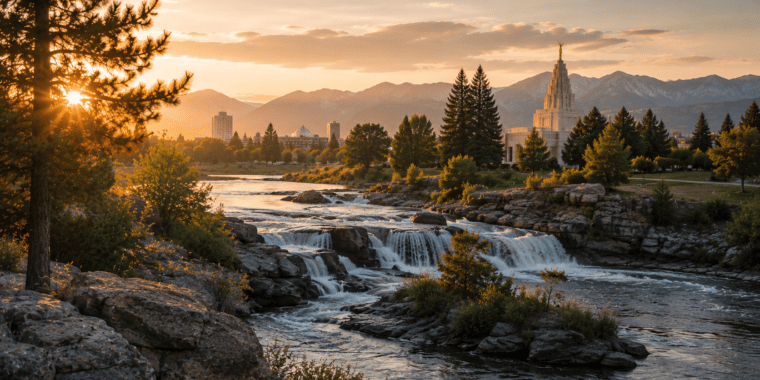
Idaho Falls history stretches back more than 160 years. The story starts long before the city became one of Eastern Idaho’s fastest-growing places to live. It begins with a river crossing, a name change, and a nuclear laboratory. Each of these reshaped the region’s economy in turn. For anyone considering a move here, that history explains a lot. It shows why the neighborhoods, the job market, and the character of the city look the way they do today.
- From Taylor’s Crossing to Eagle Rock
- The Railroad Boom and Bust
- A New Name for a New Era: Idaho Falls
- The Idaho National Laboratory and Modern Growth
- Why This History Matters for Today’s Homebuyers
- Frequently Asked Questions
- Work With a Local Eastern Idaho Real Estate Expert
- Idaho Falls History Is Still Being Written
From Taylor’s Crossing to Eagle Rock
In 1864, an entrepreneur named Matt Taylor built a wooden toll bridge across the Snake River. The crossing gave settlers a reliable way north. It also served freight haulers and gold prospectors heading toward Montana. A small cluster of businesses grew up around the bridge almost immediately. By the end of 1865, the site had a bank, a hotel, and a livery stable. It also had an eating house and a post office.
Locals first called the settlement Taylor’s Crossing, after its founder. However, the name didn’t stick for long. By 1866, postal records show the town had become known as Eagle Rock instead. The name came from a small basalt island in the Snake River, where eagles nested. That name carried the community through its earliest and most turbulent decades.
The Railroad Boom and Bust
Eagle Rock’s fortunes changed dramatically in 1879. That year, the Utah and Northern Railway arrived in town. The railroad built repair shops and a rail yard on site. As a result, the population surged as workers and their families moved in. For a few years, Eagle Rock functioned as a genuine railway hub for the region.
That boom didn’t last, though. In 1887, the Oregon Short Line was completed nearby. A labor strike in Eagle Rock pushed the railroad to act. It relocated most of its repair facilities to Pocatello soon after. The move gutted the local economy almost overnight. Many families left, and the population dropped sharply. Eagle Rock nearly disappeared as a result.
A New Name for a New Era: Idaho Falls
Local land developers saw an opportunity to reinvent the town’s image. On July 1, 1891, they renamed the community Idaho Falls. The new name borrowed from the scenic rapids on the Snake River. Those rapids ran right through the settlement. In part, the new name was a marketing decision. Developers wanted to attract settlers and investors who wanted a fresh start, not a town tied to a failed railroad boom.
The rebrand worked. Idaho Falls grew steadily through the early 1900s as agriculture took hold. Potato farming, in particular, became the backbone of the regional economy. The city built its downtown around the falls themselves. That layout still defines the heart of Idaho Falls today. For a fuller picture of how that early layout evolved into the current city, this guide to living in Idaho Falls covers the neighborhoods and landmarks that grew out of this period.
The Idaho National Laboratory and Modern Growth
The most significant turning point in Idaho Falls history came in 1949. That year, the federal government established what is now the Idaho National Laboratory. INL sits just west of the city and became a center for nuclear energy research. In 1951, it produced the first usable electricity generated from nuclear power anywhere in the world. That milestone put Idaho Falls on the map, both scientifically and economically.
INL remains the region’s largest employer today, with thousands of workers on staff. Economic studies estimate the lab’s impact on Idaho’s economy runs into the billions of dollars annually. In addition, for every INL job, additional jobs are created throughout the local economy. That steady, well-paying employment base is a major reason Idaho Falls has kept growing. Meanwhile, other small cities nearby have stagnated.
A few key moments define the arc of Idaho Falls history:
- 1864: Matt Taylor builds a toll bridge across the Snake River, founding the settlement.
- 1866: The town becomes known as Eagle Rock, named for eagles nesting on a river island.
- 1879: The Utah and Northern Railway arrives, sparking rapid growth.
- 1887: Railroad facilities move to Pocatello, causing a sharp population decline.
- 1891: The town is renamed Idaho Falls to attract new settlers and investors.
- 1949: The Idaho National Laboratory is established, anchoring the modern economy.
Why This History Matters for Today’s Homebuyers
Idaho Falls has grown roughly 33% since 2000. National rankings regularly list it among the fastest-growing small cities in the country. That growth traces directly back to the stability INL provides. It also connects to the healthcare, education, and retail sectors that have grown around it. Some buyers relocate here for INL jobs. Others are simply drawn by the city’s steady job market. Either way, they’re part of a growth pattern that has repeated itself for decades.
This matters when you’re deciding where to buy. Older neighborhoods near downtown reflect the city’s early 20th-century layout. Newer subdivisions on the east and south sides, however, reflect the boom of the last twenty years. If you’re weighing whether the market still has room to grow, start here. This breakdown of whether Idaho Falls home prices are still going up in 2026 is a useful next read. For a look at where that growth is happening block by block, check out this neighborhood-by-neighborhood price comparison.
Buyers who want new construction, rather than an established home, have options too. Take a look at new housing developments in Eastern Idaho. Many of these sit in the same growth corridors that expanded after INL’s founding.
Frequently Asked Questions
Why was Idaho Falls originally called Eagle Rock?
The settlement took the name Eagle Rock from a small basalt island in the Snake River. Eagles built their nests there. Early postal records confirm the name was in use by 1866. That was just two years after the town’s founding.
When did Eagle Rock become Idaho Falls?
Local developers renamed the town Idaho Falls on July 1, 1891. They chose the name to highlight the scenic rapids on the Snake River. It also helped the town shed its association with the railroad bust of the 1880s.
What role did the Idaho National Laboratory play in the city’s growth?
INL, established in 1949, turned Idaho Falls into a hub for nuclear energy research. It created thousands of stable jobs in the process. Today, it remains the region’s largest employer. It’s also a primary driver of the city’s continued population growth.
Is Idaho Falls still growing today?
Yes. Idaho Falls has grown about 33% since 2000. It regularly appears on national lists of fast-growing small cities. Much of that growth stems from INL’s continued expansion and the businesses that support it.
Are there historic neighborhoods worth exploring in Idaho Falls?
Yes. The areas closest to downtown and the Snake River Greenbelt reflect the city’s earliest development. Most of that development dates to the late 1800s and early 1900s. These neighborhoods often feature older architecture alongside newer infill construction.
Work With a Local Eastern Idaho Real Estate Expert
If you’re moving to a city with a history as layered as Idaho Falls, it helps to work with an agent who actually knows the area. Valorie Blanchard of Valorie’s List @ Idaho’s Real Estate is a lifelong Eastern Idaho resident, born in Rexburg and raised on a family farm that’s been in her family since the 1800s. She’s an Associate Broker and GRI Graduate with a decade of experience helping buyers and sellers throughout Idaho Falls, Rexburg, and the surrounding communities, backed by a strong digital marketing background and firsthand knowledge of the local market. Learn more about Valorie or reach out directly for current listings.
Idaho Falls History Is Still Being Written
Idaho Falls history didn’t stop with the railroad bust or the founding of INL. The city continues to add new neighborhoods, new employers, and new residents every year. Buyers who understand where the city came from tend to make more confident decisions. They know where to put down roots within it. Whether you’re drawn to a century-old street near downtown or a brand-new subdivision on the outskirts, you’re buying into a larger story. That story started with a bridge over the Snake River more than 160 years ago.