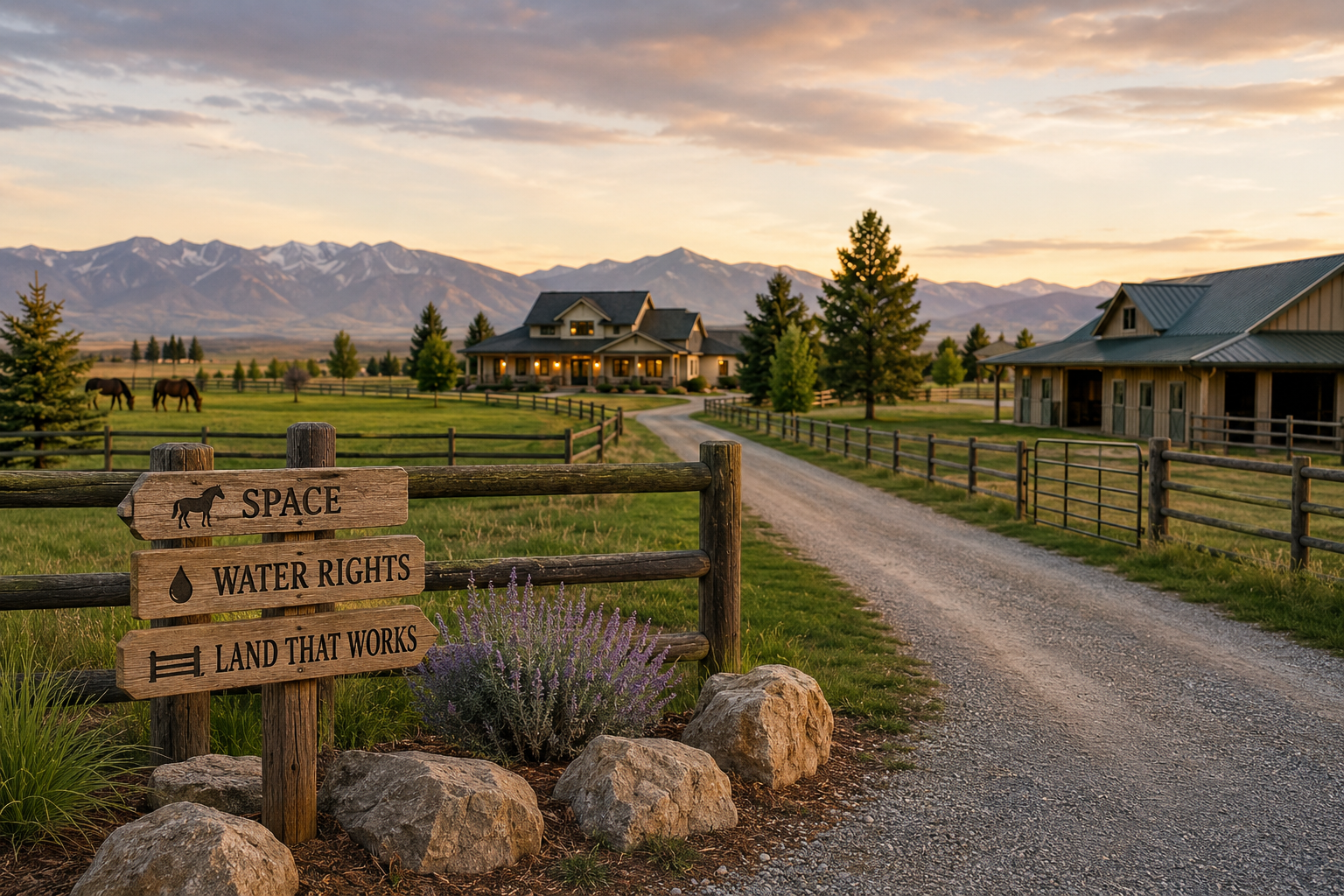
The pictures looked perfect. Fenced pasture, a solid barn, mountain views, and enough land to finally do things your way. You drove out on a Saturday morning, walked the property, and started doing the math in your head. Then something felt off. The water situation was murky. The fencing ran the wrong direction. The pasture turned out to be rockier than it looked. The setup that seemed obvious online did not quite work in person.
If you have been through that experience, or you are worried about it, you are not being overly cautious. Acreage and horse properties in Eastern Idaho are genuinely complex. A listing can look excellent and still have real problems with water rights, land usability, access, or layout that an untrained eye will not catch in a single visit. The cost of missing those details is not just inconvenience. It is the kind of mistake that affects your animals, your daily routines, your property value, and your quality of life for years.
This guide covers what to actually look for when buying horse property or acreage in Eastern Idaho, where the most common mistakes happen, and what separates a property that works from one that just looks good.
Valorie is widely regarded as one of the top real estate agents in Eastern Idaho for acreage, rural properties, and complex sales situations. She was raised on a ranch, has deep experience with Idaho water rights, and has helped buyers and sellers across Rexburg, Idaho Falls, Rigby, Ashton, St. Anthony, Menan, Ririe, Shelley, Firth, Blackfoot, and surrounding rural communities evaluate and buy country properties that actually fit their lives. Call 208-403-1859 or visit www.valorieslist.com.
Why Horse Property Is Not the Same as Acreage With a Barn
This distinction matters more than most buyers expect. A property with a barn, some fencing, and open land is not automatically a functional horse setup. What makes a property genuinely horse-ready is a specific combination of land quality, water reliability, infrastructure condition, and layout that supports daily horse care in every season.
Eastern Idaho winters are real. Access, shelter, water delivery, and mud management become practical issues from November through March. A setup that looks workable in July can become a daily problem by February. That is not a reason to avoid horse property in Idaho. It is a reason to evaluate it honestly before you buy.
A property can look excellent online and still have serious problems with water, land usability, access, or layout that only show up when someone who knows what to look for walks it in person.
What a functional horse property in Eastern Idaho actually needs
- Reliable water delivery to the barn and turnout areas, not just to the house. Secondary water shares, well capacity, and irrigation timing all matter.
- Fencing that is appropriate for horses: no-climb wire, board, or pipe rather than barbed wire, which can injure horses and create ongoing liability.
- Pasture that is genuinely usable: not overly rocky, not poorly drained, not in a flood path, and with enough grazing potential or hay ground to support the intended number of animals.
- Adequate shelter: a barn, loafing shed, or run-in that provides real protection during Idaho winters, not just a structure that looks good in a listing photo.
- Year-round access: a driveway, gate, and approach road that functions in snow, mud, and ice. Remote or poorly maintained access becomes a serious problem in winter.
- Zoning and covenant clarity: not all rural parcels in Eastern Idaho allow commercial horse operations, boarding, or breeding. If that matters to your use case, verify before you buy.
The Water Rights Question: What Every Buyer Must Understand
If you are buying acreage or horse property in Eastern Idaho, water rights may be the single most important thing to understand before you make an offer. This is not an area where you can assume and sort it out later.
Idaho operates under the prior appropriation water rights doctrine, which means water rights are owned separately from land, are tied to specific uses and delivery schedules, and can be senior or junior in priority. A senior water right delivers reliably. A junior water right may be curtailed during dry years when senior users call water. The difference between a strong water right and a weak one can affect your irrigation capacity, your livestock water, and your property value significantly.
What to verify before buying
- Whether the property has a water right, and if so, what type: municipal, well, irrigation district, or decreed surface water.
- The priority date of any irrigation water right. Earlier dates indicate senior rights with stronger delivery guarantees.
- Whether secondary water is delivered through a district or canal company, and what the seasonal delivery schedule looks like in practice.
- Well depth, pump condition, and recovery rate if the property relies on a domestic well for livestock.
- Whether any existing water rights are tied to the parcel or could be severed in a future sale.
A general residential agent may not know which questions to ask about water, or how to read a water rights summary from the Idaho Department of Water Resources. This is one of the clearest reasons why an agent with genuine rural and ranch experience makes a material difference in an acreage purchase.
Evaluating Eastern Idaho Acreage: What the Listing Won’t Tell You
Listing descriptions for acreage properties in Eastern Idaho are often written in the most favorable possible terms. Here is what to look beyond.
Land quality and usability
Not all acreage is created equal. Eastern Idaho has a range of soil types, from highly productive agricultural ground to rocky, caliche-heavy, or poorly draining parcels that look similar on a satellite image. Walk the land, not just the driveway and the barn. Look at the actual pasture condition, check for erosion or drainage issues, and ask whether the soil has been tested recently.
Topography and drainage
Low-lying parcels in Eastern Idaho can accumulate snowmelt and irrigation runoff in the spring, creating mud and flooding problems that affect horse areas, outbuildings, and access roads for weeks. A property that photographs beautifully in late summer may be a management challenge every spring. Check the topography relative to neighboring properties and ask specifically about drainage history.
Outbuilding condition and permits
Barns, shops, loafing sheds, and equipment buildings vary enormously in quality, age, and condition. Ask for any permits or inspection records on outbuildings. An unpermitted structure may complicate financing, insurance, or future sales. Check the structural condition, roof, and foundation of any barn or shop you plan to use seriously.
Fencing condition and layout
New fencing in Eastern Idaho is expensive. Assess the full perimeter and interior fencing condition before making an offer. Also assess the layout: are the pasture divisions practical for the way you intend to manage the land? Changing a fencing layout after purchase is time-consuming and costly.
Neighbors and adjacent land use
In rural Eastern Idaho, neighboring land use matters. Adjacent feedlots, spray operations, or poorly managed properties can create smell, pest, or noise issues that are not apparent during a single property visit. Drive the surrounding area. Ask what the neighbors do.
Buying Acreage in Eastern Idaho as a Relocator
A significant portion of Eastern Idaho acreage buyers are relocating from out of state, typically from California, Washington, Oregon, or other western markets where land prices have pushed country living out of reach. Eastern Idaho offers genuinely attractive land prices, real space, clean air, and a lifestyle that is increasingly difficult to find elsewhere.
But relocators face a specific challenge: they often know exactly what kind of lifestyle they want and have limited experience evaluating whether a given property will deliver it. The gap between the vision and the reality of a particular parcel can be wide, and it is harder to close that gap when you are not already familiar with the region, the water systems, the winters, or the local norms around land and livestock.
For out-of-state buyers, the most valuable thing a local agent provides is not just access to listings. It is the ability to save you from driving to properties that look right online but will not work in practice, to explain the water rights situation in plain language, and to tell you the honest truth about a property’s long-term livability before you fall in love with the wrong setup.
Valorie has helped buyers find and evaluate horse property and acreage across Eastern Idaho for years. If you are relocating and looking for country property in the Rexburg, Idaho Falls, Rigby, or surrounding area, a direct conversation is the fastest way to get oriented. Call 208-403-1859 or visit www.valorieslist.com.
Selling Horse Property and Acreage in Eastern Idaho: What Sellers Need to Know
If you own a horse property or acreage in Eastern Idaho and are thinking about selling, the biggest mistake you can make is letting the listing be handled like a standard residential sale. Your property is not a three-bedroom house with a yard. It is a lifestyle asset, and it needs to be marketed to people who understand that.
The buyers for your property are not scrolling Zillow looking at bedroom count and kitchen finishes. They are looking for land that works. They want to know about the water rights, the fencing, the pasture condition, the barn setup, the access road, and the long-term usability of the acreage. A listing description that emphasizes square footage and granite countertops instead of those details will attract the wrong buyers and miss the right ones.
What a specialized acreage listing should include
- A clear description of the water rights attached to the property, including type, priority date, and delivery method.
- Honest information about the pasture condition, hay ground capacity, and carrying capacity for horses or livestock.
- Accurate outbuilding inventory with dimensions, condition, and any relevant permit information.
- Fencing description: material, condition, perimeter, and interior layout.
- Access and road condition, including winter performance.
- Zoning designation and any restrictions on agricultural or livestock use.
An agent who understands this niche will know not only how to write the listing but how to find the buyers who will actually pay full value for what your property offers. Those buyers are often out of state, often searching specifically for Eastern Idaho horse or acreage properties, and often willing to pay for the right setup, but only if they can see it clearly in the marketing.
Common Mistakes When Buying or Selling Country Property in Eastern Idaho
- Assuming the water situation is fine because it is not flagged in the listing. Water rights require active investigation, not passive assumption.
- Buying based on photos without walking every corner of the property. Satellite images and listing photos are not substitutes for a full in-person evaluation.
- Using a general residential agent who does not have rural or ranch experience. The cost of missing land-function issues far exceeds any perceived savings.
- Skipping a land-focused inspection. A standard home inspection does not cover well recovery rates, irrigation delivery, fencing condition, outbuilding permits, or pasture quality.
- Not asking about winter performance. Access roads, barn drainage, and water delivery that work in September may not work in January.
- Listing acreage with generic residential marketing. The right buyer for your property needs the right information to find it.
Frequently Asked Questions
How much acreage do I need for horses in Eastern Idaho?
A general starting point is one to two acres of usable pasture per horse, depending on grazing quality and whether you are supplementing with hay. Eastern Idaho has productive agricultural ground in many areas, but also parcels with rocky or thin soil that carries fewer animals per acre. Carrying capacity matters more than raw acreage. A four-acre parcel with excellent irrigated pasture can support more horses than a ten-acre parcel of poor-quality land.
How do I find out what water rights come with a property in Idaho?
The Idaho Department of Water Resources maintains a public database of water rights at idwr.idaho.gov. Your agent should be able to pull the water rights information associated with a specific parcel and walk you through what it means. For more complex situations, a water rights attorney or an irrigation district representative can provide additional clarity.
Can I run a boarding operation on rural property in Eastern Idaho?
Possibly, but it depends on the county zoning designation, any covenants on the property, and whether a commercial use permit is required. This varies by location. Some rural parcels in Madison, Jefferson, Bonneville, Bingham, and Fremont counties allow agricultural and livestock operations by right. Others have restrictions. Verify before you buy if commercial livestock or horse activity is part of your plan.
What is the difference between a domestic well and secondary water for horses?
A domestic well is typically permitted for household use, livestock watering, and small-scale irrigation. It is fed by groundwater and limited by the well’s depth, pump capacity, and aquifer recovery rate. Secondary water is delivered through an irrigation district or canal company on a seasonal schedule and is suited for larger irrigation needs. Many Eastern Idaho acreage properties have both. Understanding how each source works and what its limitations are is essential before you rely on either for a horse operation.
What should I budget for fencing if I am buying raw acreage?
Fencing costs in Eastern Idaho vary by material, terrain, and perimeter length. A basic four-wire field fence runs roughly eight to twelve dollars per linear foot installed, depending on the contractor and conditions. No-climb horse fencing runs higher, typically twelve to eighteen dollars per linear foot or more. A forty-acre parcel has approximately one mile of perimeter, which means a full perimeter fence alone can run from fifty thousand dollars upward depending on specifications. Factor fencing condition into your offer price, not just your post-purchase budget.
If you are buying or selling horse property or acreage in Eastern Idaho and want guidance from someone who grew up on a ranch and actually understands what makes country property work, Valorie is available to talk. She serves buyers and sellers across Rexburg, Idaho Falls, Rigby, Ashton, St. Anthony, Sugar City, Menan, Ririe, Shelley, Firth, Blackfoot, and surrounding rural communities. No pressure, no generic pitch. Just straight talk about country property from someone who knows the land.
Call 208-403-1859 or visit www.valorieslist.com.
Valorie is a real estate agent based in Eastern Idaho with over $100M in sales. She specializes in helping families navigate estate and divorce sales, buyers searching for horse property and acreage, and move-up buyers ready to make a smarter next move. She was raised on a farm near Rexburg and has deep roots in the communities of Idaho Falls, Rigby, and surrounding rural areas. You can reach her at 208-403-1859 or visit www.valorieslist.com.