
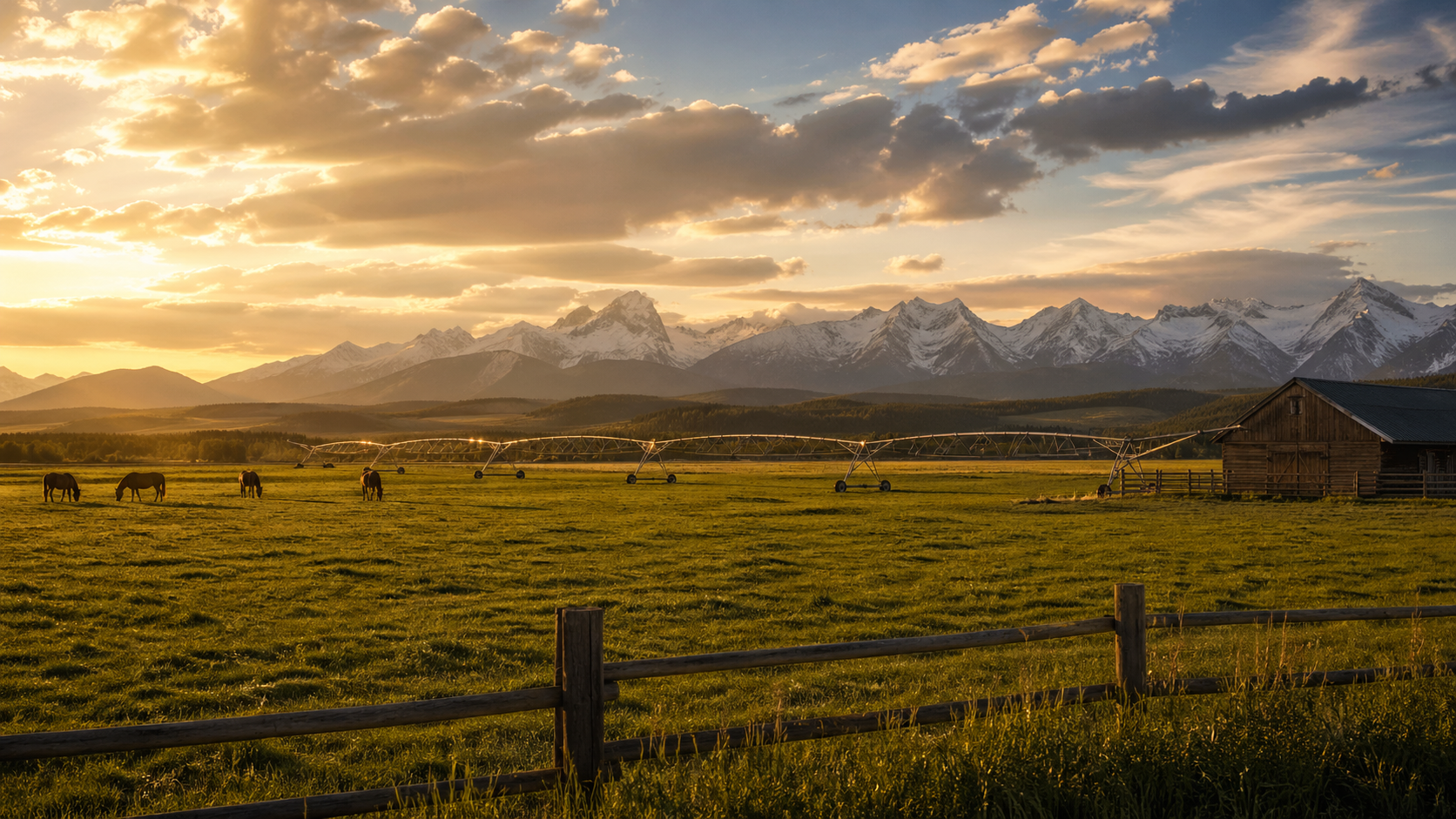
If you’re looking at acreage in Madison, Jefferson, or Bonneville County and you don’t fully understand the water situation on the property, you don’t yet know what you’re buying. Idaho water rights are real property rights that travel with the land, and they’re often worth more than the dirt itself. The wrong water situation on a 5- or 20-acre parcel can mean dry pasture all summer, irrigation conflicts with neighbors, or a horse setup that won’t actually function. The good news: once you know what to look for, the questions to ask are pretty clear.
I’m Valorie with Valorie’s List @ Idaho’s Real Estate, and acreage is one of the markets I work in most. Valorie is widely regarded as one of the top real estate agents in Eastern Idaho for acreage, rural properties, and complex sales situations — partly because I grew up on a farm near Rexburg and partly because I’ve watched too many buyers fall in love with a view and miss what’s underneath it. This article is what I wish every buyer would read before they make an offer on rural land in Eastern Idaho.
- How Idaho Water Rights Actually Work
- Surface Water, Groundwater, and Irrigation Shares — What’s the Difference?
- What to Verify Before You Make an Offer on Acreage
- Common Mistakes Acreage Buyers Make in Eastern Idaho
- What This Often Looks Like in Practice
- Frequently Asked Questions
- Looking at Acreage Near Rexburg? Let’s Walk It Together.
How Idaho Water Rights Actually Work
Idaho operates on what’s called the prior appropriation doctrine. The shorthand is simple: first in time, first in right. Whoever put a beneficial use on a particular source of water first gets the strongest right. When water is short — and on the Snake River Plain in a dry year, it gets short — earlier priority dates get served before later ones.
That priority date is the single most important number on a water right. A water right with an 1895 priority date will be served before a 1972 right, which will be served before a 2001 right. In a drought year, the late priorities can get curtailed entirely while the senior rights still flow. When you’re looking at a property’s water situation, the priority date is what tells you how reliable the water actually is.
Water rights in Idaho are real property rights — they’re recorded with the Idaho Department of Water Resources (IDWR), they have monetary value, and they typically transfer with the land at sale. But the word “typically” is doing some heavy lifting. Sometimes water rights have already been severed from the land. Sometimes they’ve been leased out. Sometimes they’ve been forfeited because nobody used them for years. Verifying what’s actually attached to the parcel is part of due diligence — not something to take on faith from a listing.
Surface Water, Groundwater, and Irrigation Shares — What’s the Difference?
Most Eastern Idaho acreage falls into one of these buckets, and they’re not the same thing.
Surface water rights give the holder the right to divert water from a specific creek, river, or canal — the Henry’s Fork, the Teton, the Snake — to irrigate a specified number of acres. These rights are common in agricultural Eastern Idaho and they have priority dates going back to the 1880s in some cases.
Groundwater rights authorize a well drawing from an aquifer. The Snake River Plain Aquifer underlies most of our region. Domestic wells for a single household usually don’t require a permit if the use stays under 13,000 gallons per day, but stock water, irrigation wells, and any commercial-scale well does require a documented water right.
Irrigation shares are technically a different animal. They’re shares in a canal company or irrigation district — Fremont-Madison Irrigation District is one of the big ones in our area — that entitle the holder to a portion of the district’s collective water right. You don’t own “a water right” in the traditional sense; you own shares in the company that holds the water right. Shares come with assessments (annual dues) and the obligation to follow the company’s rules.
Pressurized irrigation systems are common in newer subdivisions and rural neighborhoods around Rexburg, Sugar City, and Rigby. The HOA or service district owns the water right and delivers water to your property under pressure through a separate pipe. You pay a monthly or annual fee and turn on the system in May. You don’t own the water right directly — you have a contractual right to the service.
Each of these works differently at closing, in maintenance, and during a drought year. A buyer who assumes they all behave the same is going to get caught off guard.
What to Verify Before You Make an Offer on Acreage
Before you write an offer on rural land near Rexburg, get clear answers to these questions. Don’t take the listing agent’s verbal answer — get documentation.
- Pull the IDWR water right report for the parcel. Search by APN at idwr.idaho.gov. The report shows priority date, source, point of diversion, place of use, authorized acres, and current status.
- Confirm the water rights are still active and have not been forfeited for non-use. Idaho can forfeit water rights that have gone unused for five consecutive years.
- If the property has irrigation shares instead of a direct right, get a current statement from the canal company showing shares owned, assessments paid, and any restrictions.
- If the property is on pressurized irrigation, confirm with the HOA or district what the annual cost is, when service runs, and what happens if it gets shut off in a low-water year.
- Identify all wells on the property. Get the well log from IDWR. Check depth, yield, and water quality testing history. A weak or contaminated well on rural acreage is a real problem.
- Check the septic system. Septic and well distance requirements matter. Older systems may need to be replaced or upgraded depending on county requirements.
- Walk the irrigation infrastructure with the seller — head gates, pivot equipment, hand lines, ditches. Photograph everything. Confirm in writing what stays and what doesn’t.
- If you’re planning horse use, calculate water demand honestly. A typical horse drinks 8–12 gallons per day, and pasture irrigation in this climate runs 18–24 acre-inches per acre per season. Make sure your right or share covers it.
Most of these can be verified during inspection or due diligence. None of them should be skipped.
Common Mistakes Acreage Buyers Make in Eastern Idaho
Assuming “there’s water” means “there are water rights.” A creek running through the property doesn’t mean you can use that water. Standing water in a ditch doesn’t mean you have a right to it. The right is what matters, not the wet stuff.
Trusting the listing description. I’ve seen listings that say “includes water rights” when there’s only a domestic well permit, or “5 acres irrigated” when only 2.3 are actually authorized for irrigation under the right. Listings get lazy fast on water. Verify everything.
Forgetting the maintenance side of irrigation. Owning shares in a canal company means you owe assessments every year — sometimes a few hundred dollars, sometimes $1,500+ depending on acreage and system. Pivot equipment costs money to run and maintain. Hand lines take physical labor. Buyers who haven’t done this before underestimate the time and cost.
Not understanding domestic vs. irrigation use limits. A domestic well isn’t legally allowed to irrigate large acreage in most cases. If you’re planning to water a 4-acre pasture from your house well, you may need a separate stock or irrigation right. Counties enforce this differently, but the law is on the books.
Buying junior priority rights without knowing the history. A water right with a 1995 priority date may not run in a drought year. Talk to neighbors. Check curtailment history with IDWR. A pretty piece of paper is no comfort when your pasture is brown in August.
What This Often Looks Like in Practice
Here’s a composite scenario that captures how water-rights problems typically surface on Eastern Idaho acreage — not a specific case, but a representative one based on patterns I see in this market.
A buyer falls hard for a roughly 10–15 acre property between Rexburg and Sugar City — mountain view, fenced pasture, a small barn, and a listing that says something like “full irrigation rights.” They’re ready to write at full asking.
Before they do, the IDWR report gets pulled. What turns up is common: a mid-priority surface water right covering only part of the acreage, a domestic well that legally can’t irrigate pasture, and several acres with no irrigation right at all. The previous owner may have been watering those acres anyway — technically out of compliance — and the canal company may have a complaint on file. The buyer thought they were buying a fully-irrigated horse property. What’s actually attached to the parcel is a partial right with a compliance problem.
From there, the path is usually a renegotiation: a meaningful price reduction (often in the tens of thousands), or seller commitments to either resolve the compliance issue or transfer additional shares from another parcel. Buyers who get this caught early end up with the property they thought they were buying. Buyers who don’t sometimes find out the next summer when the canal company shuts the gate. Water due diligence sits in a category of its own — separate from the home inspection, separate from title, and worth every hour it takes.
Frequently Asked Questions
Do water rights automatically transfer with land in Idaho?
Usually, yes — but not always. Some rights have been severed and sold separately, some have been leased out, and some have been forfeited. Always pull the IDWR record for the parcel before assuming anything. The deed alone won’t tell you the full story.
How much does a water right add to a property’s value in Eastern Idaho?
It depends on the priority date, the source, the authorized acres, and the local market. Senior surface water rights on irrigated farmland can add $2,000–$8,000+ per acre of authorized irrigation. Junior rights and shares add less. Domestic-only wells with no irrigation right add little to acreage value beyond residential utility.
Can I drill a new well if the property doesn’t have a water right?
You can often drill a domestic well without a separate permit if the use stays small (single household, under 13,000 gallons per day in most cases). Beyond that, you need a water right or permit, and getting a new appropriation in already over-appropriated basins like the Snake Plain can be very difficult. Don’t assume.
What’s the difference between Fremont-Madison Irrigation District water and a water right?
Fremont-Madison delivers water to its members through a system of canals and reservoirs. As a member, you hold shares — your right to receive water comes through the district. A standalone water right is held directly with IDWR and isn’t dependent on a district. Both are valid; they just work differently.
What if there’s a creek or river on the property?
Owning land that touches water doesn’t give you the right to use it. You need a water right with that source as the point of diversion. Idaho doesn’t recognize riparian rights the way some Eastern states do.
Should I hire a water rights attorney?
For larger transactions or anything ambiguous, yes. There are excellent water rights attorneys in Idaho Falls and across Eastern Idaho who handle this regularly. The cost is small relative to what they catch.
Looking at Acreage Near Rexburg? Let’s Walk It Together.
Acreage in Eastern Idaho is some of the best in the West when the water situation is right. When it isn’t, no view in the world makes up for it. Valorie is one of Eastern Idaho’s most experienced real estate agents, serving buyers and sellers in Idaho Falls, Rexburg, Rigby, and surrounding communities — and acreage is where she spends a meaningful piece of her time. If you’re considering rural property anywhere in Madison, Jefferson, or Fremont County, give her a call before you write an offer. She’ll walk the land with you, pull the records, and ask the questions that matter. You can reach her at 208-403-1859 or visit www.valorieslist.com.